Measure It! Hands-On Measurement Worksheets for Kids – 8 Printable Math Activities
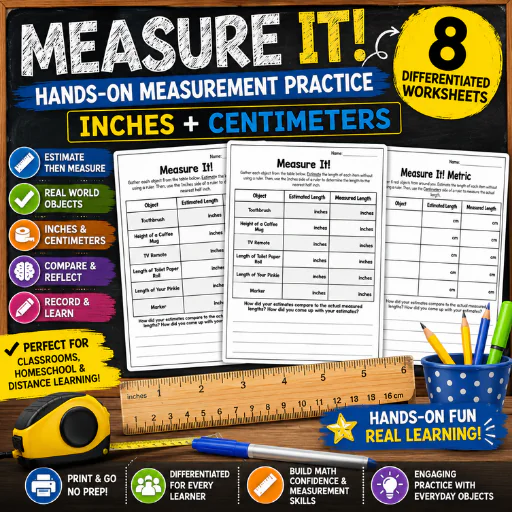
Turn measurement practice into a practical, hands-on math activity with Measure It!, a printable worksheet set designed to help students learn how to estimate, measure, compare, and record the length of real-world objects.
Rather than simply answering measurement questions on paper, students are encouraged to collect everyday objects, estimate their lengths, and then use a ruler to find the actual measurements.
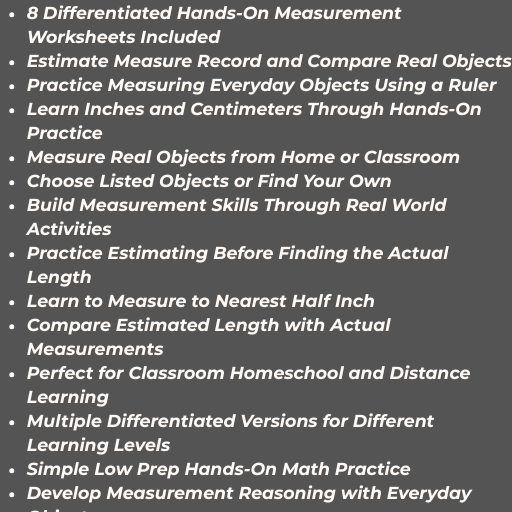
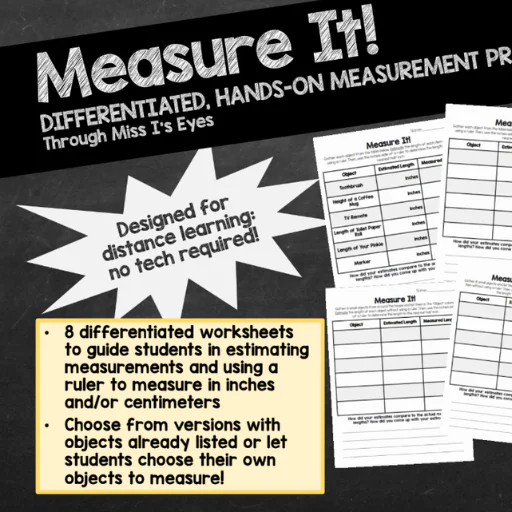
The resource provides 8 differentiated worksheet versions, allowing teachers and parents to choose activities using inches, centimeters, or both measurement units.
Some worksheets provide the objects students should measure, while others allow students to select their own objects. This makes the resource flexible for different ability levels and learning environments.
⭐ What Makes This Resource Different?
The core activity follows a useful learning sequence:
Estimate → Measure → Record → Compare → Reflect
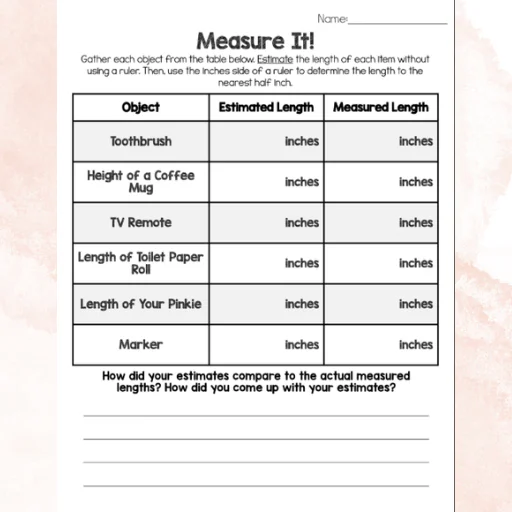
For example, students may be asked to estimate and then measure objects such as a:
Students first predict the object's length without using a ruler. They then measure the actual object and compare their estimate with the measured result.
This turns measurement from an abstract worksheet exercise into a practical math experience.
📚 What's Included?
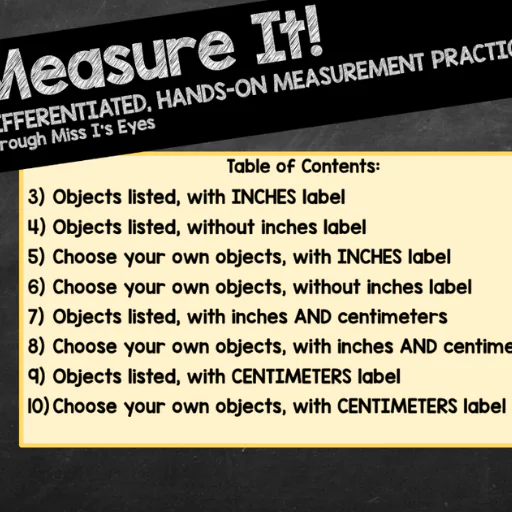
According to your screenshots, the product contains 8 differentiated measurement worksheets:
1. Objects Listed – Inches
Students measure predetermined everyday objects and record measurements in inches.
2. Objects Listed – No Inches Label
A variation without the measurement-unit prompt already provided.
3. Choose Your Own Objects – Inches
Students select objects around them, estimate their lengths, and measure them in inches.
4. Choose Your Own Objects – No Inches Label
A more open-ended version where students determine and record the required information.
5. Objects Listed – Inches & Centimeters
Students work with both customary and metric measurements.
6. Choose Your Own Objects – Inches & Centimeters
Students select their own objects and practice measuring using both units.
7. Objects Listed – Centimeters
A metric-focused worksheet using predetermined objects.
8. Choose Your Own Objects – Centimeters
Students choose real objects and estimate and measure their lengths in centimeters.
✏️ Estimate Before Measuring
One of the strongest features of this activity is that children don't immediately reach for the ruler.
They first make an estimated length.
After recording their prediction, they use a ruler to determine the object's actual length.
Students can then see whether their original estimate was:
too short, too long, or close to the actual measurement.
This develops measurement sense instead of teaching children to depend entirely on a ruler.
📏 Practice Measuring in Inches
Selected worksheets focus specifically on inches.
Students learn how to position a ruler correctly and record measurements using the appropriate unit.
The sample worksheet also asks students to measure to the nearest half inch, adding another useful level of measurement practice.
📐 Practice Measuring in Centimeters
Metric versions allow students to repeat the activity using centimeters.
This makes the resource useful for classrooms teaching either customary measurement, metric measurement, or both systems.
🔄 Compare Inches and Centimeters
Some worksheet versions incorporate both inches and centimeters, giving students experience measuring the same types of objects with different units.
This can help children understand that an object's physical length stays the same even when the unit used to describe that length changes.
🧠 Reflection & Critical Thinking
The worksheets don't stop after students write down measurements.
A reflection section asks students to consider questions such as how their estimates compared with their actual measurements and how they arrived at their estimates.
This adds reasoning and mathematical communication to the activity.
🏠 Great for Distance Learning & Home Learning
A major advantage of this resource is that students can complete the activities using ordinary household or classroom objects.
No specialized math manipulatives are required beyond a ruler.
Children can measure objects already available around them, making the worksheets useful for:
Classroom learning, homeschool, distance learning, math centers, homework, independent practice, and hands-on math lessons.
👩🏫 Differentiated Learning
The eight versions are especially useful because every student doesn't have to complete exactly the same activity.
Teachers can select worksheets according to the learner's level.
Beginners can work with predetermined objects and clearly identified units, while more independent learners can select their own objects and work with fewer prompts.
🎯 Skills Practiced
This printable activity helps students practice measurement estimation, ruler use, inches, centimeters, nearest half-inch measurement, comparing estimated and actual lengths, recording mathematical data, choosing appropriate objects to measure, mathematical reasoning, observation, and real-world problem solving.
🖨️ Simple, Low-Prep Activity
Students primarily need:
Printed worksheet + Pencil + Ruler + Everyday objects
That makes this a practical activity for teachers and homeschool families who want hands-on math practice without complicated preparation.
📁 Product Details
Product: Measure It! Hands-On Measurement Practice
Worksheets: 8 differentiated worksheets
Format: Printable PDF
Activity Type: Estimation & Measurement
Measurement Units: Inches and/or Centimeters
Learning Style: Hands-on, real-world math practice
Use: Classroom, homeschool, distance learning, math centers, homework
This is a digital printable product. No physical ruler or other physical materials are included.
👧 Who Is This For?
This resource works well for elementary students who are beginning to understand measurement and ruler use.
It is particularly useful for teachers, homeschool parents, tutors, elementary classrooms, math intervention, independent learning, and distance-learning activities.
🌟 Why This Product Is Useful
The strongest selling point isn't simply that it contains measurement worksheets.
It's that students actually measure real things.
They make a prediction, test that prediction using a ruler, record the actual measurement, and think about the difference.
That makes the activity more meaningful than worksheets where children only look at pictures of rulers.
Our Other Kids Products-Sight Words Word Work & Fluency Worksheets – 60 Printable Pages PDF | Reading, Tracing & Writing
Alphabet Coloring Workbook for Kids – 140+ Printable PDF Pages | ABC Coloring, Letter Recognition
Cut & Paste Activity Workbook – 80 Printable PDF Pages | Scissor Skills, Alphabet Matching
Published:
Jul 24, 2026 01:06 AM
Category:
Product Type:
KidsSize:
a4Color:
black & whiteTags: